
For many people, classical music did not begin in a concert hall.
It began in a cinema.
It began with a scene that gave them goosebumps.
A melody that made a character unforgettable.
A soundtrack that made an ending feel more emotional than words ever could.
While classical music is often associated with history, composers, and formal performances, many modern audiences first encountered its emotional power through film scores.
They may not have recognised it as classical music at the time.
But they recognised the feeling.
Before the Concert Hall Came the Movie Theatre
For many audiences, especially younger listeners, film music became the first bridge into the world of orchestral sound.
Before they knew the names of composers such as Beethoven, Mahler, or Tchaikovsky, they heard orchestras shaping the emotional world of cinema.
Film scores introduced audiences to the sound of:
- sweeping strings
- heroic brass
- delicate woodwinds
- dramatic percussion
- full orchestral crescendos
These sounds became connected to some of the most memorable moments in storytelling.
Adventures felt larger.
Fear felt closer.
Love felt deeper.
Loss felt heavier.
Through film, orchestral music became familiar without needing explanation.
Film Music Makes Emotion Easy to Understand
One reason film scores are such a powerful gateway to classical music is that they help audiences understand orchestral music emotionally.
A viewer does not need knowledge in music to know when a scene feels tense.
They do not need to identify the instruments to feel wonder.
They do not need to understand orchestration to recognise heartbreak.
Film music teaches audiences how orchestral sound works through emotion.
A quiet melody can suggest loneliness.
A rising musical phrase can create hope.
A sudden percussion hit can build fear.
A full orchestral climax can turn a simple scene into something unforgettable.
In this way, film scores make the emotional language of classical music more accessible.
The Orchestra Became Part of Popular Culture
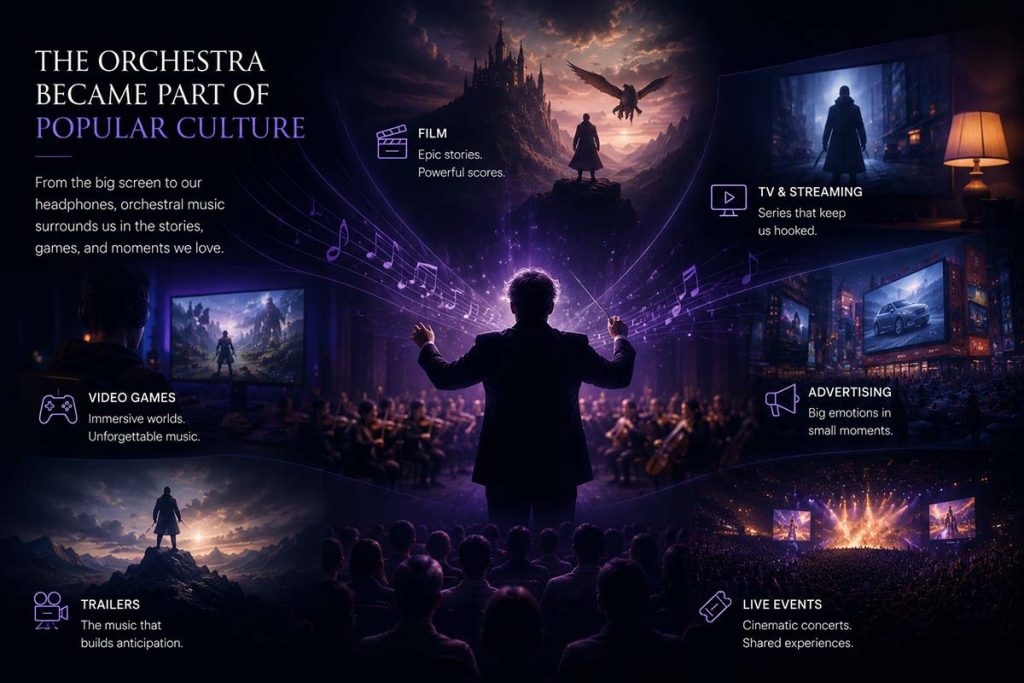
Classical music is sometimes seen as distant from modern life, but orchestral sound is already deeply embedded in popular culture.
It appears in:
- films
- television series
- trailers
- video games
- advertisements
- live cinematic concerts
Many people who say they do not listen to classical music still have favourite soundtracks.
They may love the emotional scale of a fantasy film, the tension of a thriller, or the nostalgia of a childhood movie theme.
That connection matters.
It shows that audiences are often more familiar with orchestral music than they realise.
Film Scores Helped Remove the Intimidation
Classical music can sometimes feel intimidating because people assume they need prior knowledge to enjoy it.
Film scores help break that barrier.
They show audiences that orchestral music can be:
- dramatic
- emotional
- exciting
- cinematic
- accessible
- deeply human
The music is not presented as something to be studied first.
It is experienced directly.
Audiences feel the impact before they analyse it.
That emotional connection is often the beginning of curiosity.
A person who loves a film score may later explore live orchestral concerts, classical works, or composers who influenced cinematic music.
Classical Traditions Still Shape Film Music
Film music did not appear from nowhere.
Many of the techniques we associate with modern film scores have their roots in classical and orchestral music. The use of recurring themes, dramatic development, instrumental colour, and emotional storytelling through music can all be traced back to earlier orchestral traditions.
One important influence was the concept of the leitmotif, a recurring musical idea associated with a character, place, or idea. Popularised by composers such as Richard Wagner in the 19th century, this approach remains a cornerstone of film scoring today.
The connection between classical music and film became even stronger through composers such as Erich Wolfgang Korngold, who brought the richness of late-Romantic orchestral writing to Hollywood in the 1930s and 1940s. His scores for films like The Adventures of Robin Hood helped establish the sound of the modern adventure film.
Later, composers such as Bernard Herrmann expanded the possibilities of film music through innovative orchestration and psychological storytelling, particularly in his collaborations with Alfred Hitchcock. Herrmann demonstrated how music could become an essential part of a film’s narrative rather than simply accompanying the action.
In the 1970s, John Williams reintroduced large-scale symphonic writing to mainstream cinema. Drawing inspiration from composers such as Wagner, Holst, Korngold, and Tchaikovsky, his scores for Star Wars, Superman, E.T., Indiana Jones, and Jurassic Park helped a new generation discover the power of orchestral music.
Other influential composers, including Jerry Goldsmith, James Horner, Howard Shore, and Hans Zimmer, continued to build on these traditions while developing their own distinctive musical voices.
For many listeners, film scores have become a modern gateway into a musical tradition that stretches back hundreds of years.
Why Film Music Stays With Us
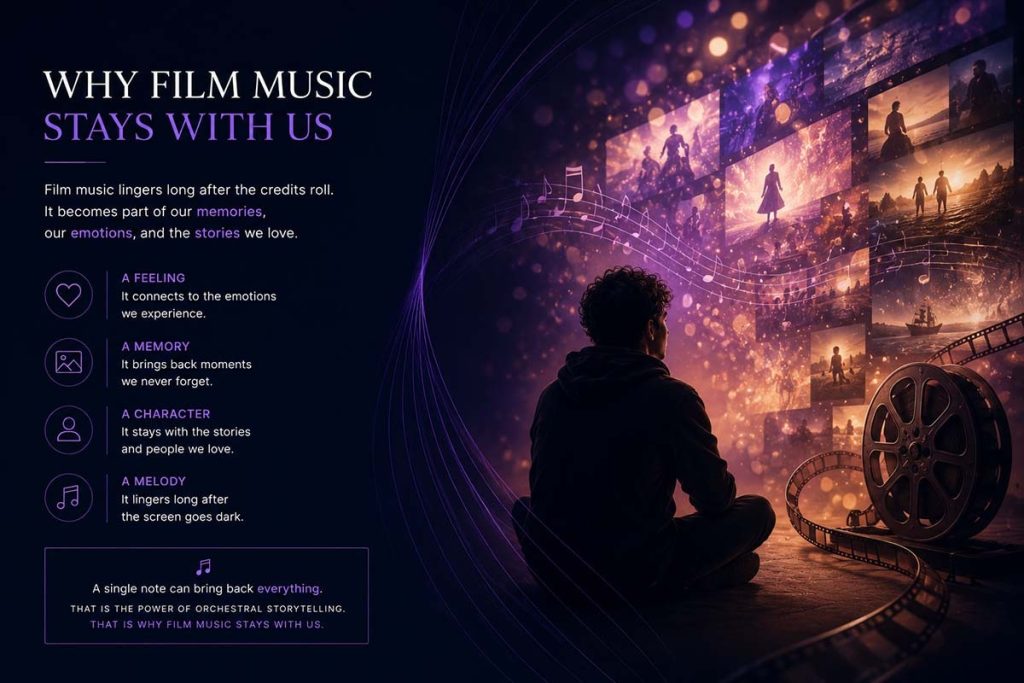
The strongest film scores do more than support a scene.
They become part of memory.
Sometimes, people remember the music as much as the image itself.
A melody can bring back:
- a character
- a scene
- a feeling
- a childhood memory
- a moment of wonder
That is the power of orchestral storytelling.
Music attaches emotion to memory in a way that is immediate and lasting.
This is one reason film scores have helped so many people connect with classical and orchestral music. They make the emotional impact personal.
From Screen to Stage
In recent years, live film score concerts have become increasingly popular.
Audiences gather to hear orchestras perform music from beloved films, often with the same sense of excitement usually associated with cinema or popular music events.
These concerts show how naturally film music can lead audiences toward live orchestral experiences.
For some people, hearing a film score performed live becomes their first orchestra concert.
It allows them to experience familiar music in a new way.
The screen may have introduced them to the sound.
But the live orchestra lets them feel its full scale.
Final Thoughts
Film scores have become one of the most powerful gateways to classical music for modern audiences.
They have shown people that orchestral music can make stories feel larger, emotions feel deeper, and memories feel more vivid.
For many listeners, the first emotional connection to classical music did not come from knowing a composer’s name.
It came from feeling something during a film.
And that is a meaningful place to begin.
Because before audiences understand classical music intellectually, they often understand it emotionally.
The music reaches them first.
The curiosity follows.

